
AI Integration in Property Management: A Case Study
AI Integration in Property Management: A Case Study
How We Built Data Intelligence for a Luxury Short-Term Rental Platform
We recently completed an AI integration project for a property management platform that handles high-end short-term rentals. The client manages the complete operation: booking platform, cleaning coordination, maintenance scheduling, and guest services.
The challenge was clear. They had extensive data across multiple systems but couldn't easily answer business-critical questions. A simple question like "Do properties with jacuzzis generate enough revenue to offset their maintenance costs?" required days of manual analysis across different spreadsheets and databases.
This article shares what we learned from the project, what worked, and what we see as promising next steps for AI in this industry.
The Challenge
The client had comprehensive data but it was fragmented across multiple sources:
- Historical booking and revenue data
- Maintenance logs with detailed cost breakdowns
- Cleaning schedules and labor costs
- Property features and amenities databases
- Guest feedback and incident reports
The primary pain points were:
- Time-consuming data gathering from multiple sources
- Custom dashboards that were difficult to modify
- Complex questions requiring manual reconciliation across datasets
- Days of analysis needed for strategic business decisions
Our Approach
We structured the project in three phases to address the core challenge: making fragmented data accessible and queryable.
Phase 1: Data Integration Platform
We built a platform where users can connect data sources directly without technical expertise. The key requirements we addressed:
- Simple upload process for spreadsheets and database connections
- Automatic schema detection for different data structures
- Real-time updates when source data changes
Phase 2: AI Query Interface
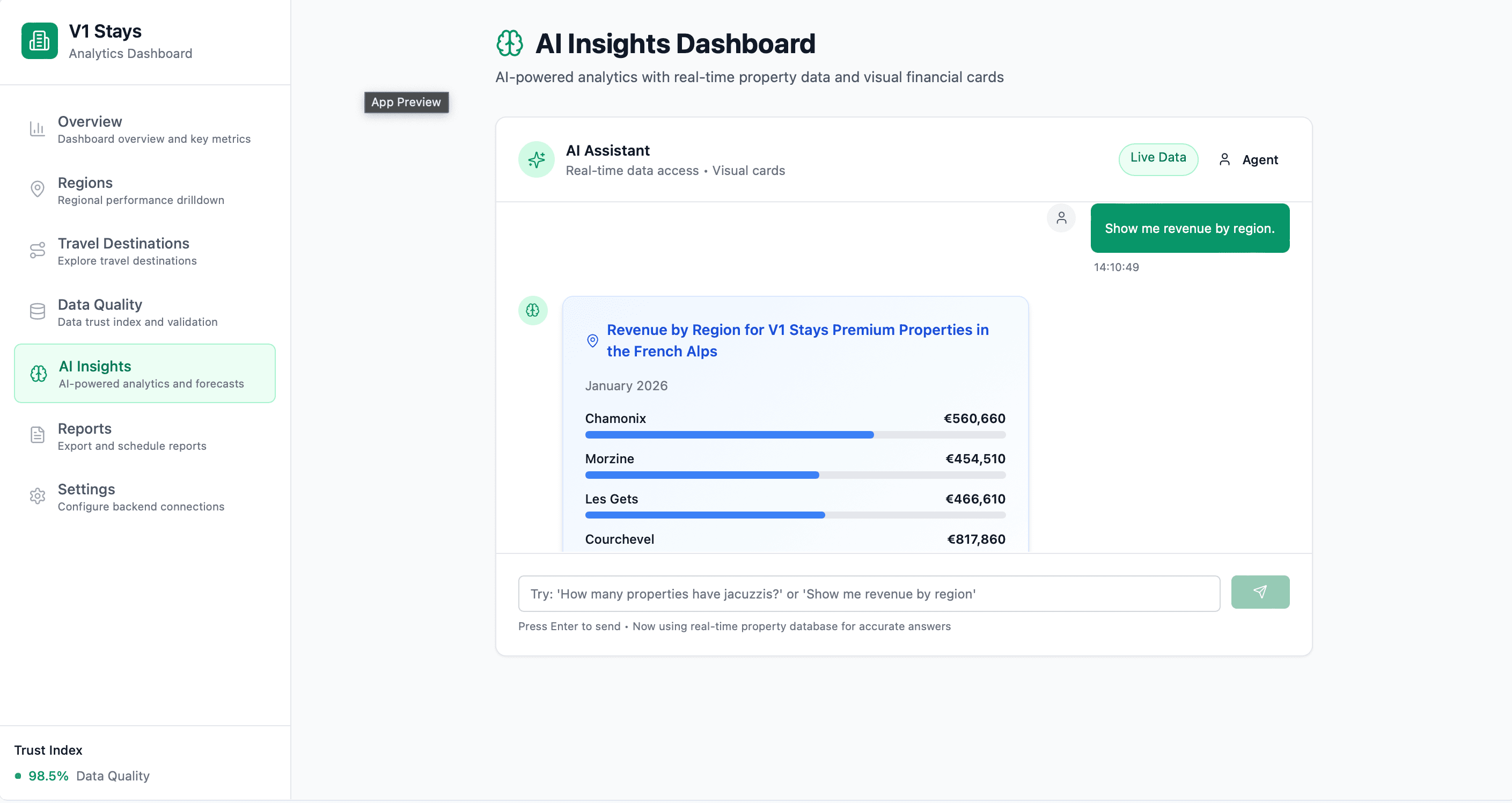
We developed an AI chat interface that allows natural language queries. The system handles:
- Automatic relationship discovery between datasets
- Multi-step reasoning for complex calculations
- Context retention for follow-up questions
- Granular filtering and comparison capabilities
The interface allows questions like: "Do properties with jacuzzis in coastal markets generate sufficient revenue to offset their maintenance costs during summer months?" These multi-dimensional queries return instant results with full data attribution.
Phase 3: Transparency and Reporting
Trust was essential for adoption. We built a comprehensive auditing system that provides:
- Source attribution for every data point used
- Clear explanation of calculations and methodology
- Confidence indicators when data is incomplete
- Instant PDF report generation for sharing results
The PDF generation feature became particularly valuable. Users can now generate board-ready reports directly from queries, complete with data visualizations and methodology notes.
Technical Innovation: Synthetic Data Modeling
An additional requirement emerged during the project: the ability to model future scenarios. The client wanted to answer questions like "What would revenue look like if we add jacuzzis to five more properties over the next 12 months?"
We developed a synthetic data generation engine that simulates performance based on historical patterns. The model accounts for:
- Seasonal demand fluctuations and booking patterns
- Estimated cancellation rates based on historical data
- Projected maintenance costs as percentage of revenue
- Average vacancy rates by property characteristics
This allows the team to test business decisions before committing capital. The feature has become one of the most-used tools for strategic planning.
Key Learnings
We identified several important insights during implementation:
1. Data Accessibility is the Primary Barrier
Most businesses already have the data needed for better decisions. The challenge is making it accessible. Once we simplified the data connection process, usage increased significantly. The key success factor: making integration frictionless enough that users don't need IT assistance.
2. Precision in Queries Matters
Users need to ask highly specific questions with granular precision. Simple queries like "Do jacuzzis increase revenue?" aren't sufficient. The system must support multi-dimensional questions that filter by location, time period, property type, and multiple cost factors simultaneously.
3. Trust Requires Transparency
Accuracy alone doesn't build confidence. Users need to see how the AI reached its conclusions. The auditing system—showing data sources, calculations, and assumptions—was essential for transforming the tool from an interesting experiment into a business-critical resource.
4. Integration with Existing Workflows
The most valuable features weren't always the most technically sophisticated. PDF report generation became critical because users need to share findings with stakeholders who weren't involved in the original query. The best AI tools integrate seamlessly into existing business processes.
Challenges and Adjustments
Not all initial approaches worked as planned. Here are the key adjustments we made:
Automatic Relationship Detection
Our first version attempted to automatically detect relationships between datasets without user input. This failed when different teams used different naming conventions for the same fields ("Property_ID" vs "PropID" vs "property_identifier"). We adjusted the approach to request minimal user guidance during setup, which dramatically improved accuracy while maintaining ease of use.
Explanation Complexity
The initial auditing system displayed technical execution details and SQL queries. Users found this unhelpful. We redesigned the explanation layer to be business-focused: "I calculated average revenue by comparing 47 properties with jacuzzis against 203 without, filtered by your selected locations" rather than showing raw SQL queries.
Future Opportunities
The project revealed significant opportunities for further AI integration in property management. We see potential in the following areas:
Predictive Maintenance: Using historical data to predict system failures before they occur, enabling proactive scheduling and cost reduction.
Dynamic Pricing Optimization: Real-time pricing adjustments based on local events, competitor rates, weather forecasts, and booking velocity.
Automated Compliance Tracking: Monitoring regulatory changes across jurisdictions and flagging properties that need license renewals or inspections.
Dynamic Dashboard Generation: On-demand visualization creation allowing users to modify displayed data in real-time.
Conclusion
The primary outcome of this project was operational transformation. The client's team now asks significantly more analytical questions than before—not because the questions became easier, but because the friction disappeared.
Property managers aren't being replaced by AI. They're being freed from time-consuming data gathering and manual calculations, allowing them to focus on interpretation, judgment, and relationship building.
We see this as the real value of AI in business: not replacing human intelligence, but amplifying it.
About Nomu Labs
Nomu Labs conducts deep-dive research into emerging AI technologies and builds custom solutions for specific industry challenges. We explore AI's frontier to deliver actionable intelligence tailored to your business.
Interested in exploring AI integration for your industry? We look forward to hearing from you.
Contact us to discuss your specific needs.